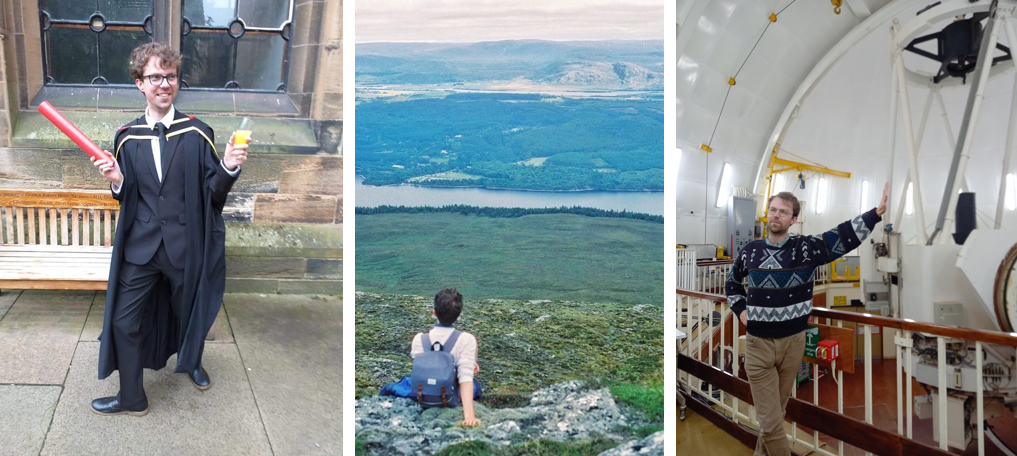
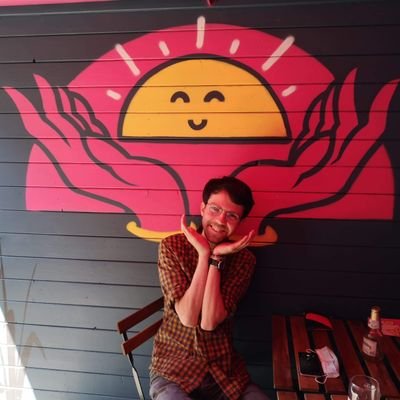
I am an ESA Research Fellow at the European Space Agency, based at the European Space Astronomy Centre (ESAC) in Madrid. My project there is self-directed and
focused on the evolution of galaxy morphology with time. I spend most of my time researching how galaxy interactions drive evolution, but I also work on Active Galactic Nuclei, galaxy clusters and
anomaly detection. Previously, I worked as a post-doctoral researcher at the Centre for Astrobiology, also in Madrid, where my work focused on classifying galaxies by morphology using machine learning techniques.
This work was conducted with Sandor Kruk, Jan Reerink and
Miguel Mas-Hesse. I completed my PhD at the University of Lancaster,
UK, under Dr Brooke Simmons, with a thesis on the relationship between galaxy interaction and galaxy formation and evolution. Prior to Lancaster,
I was an undergraduate at the University of Glasgow, where I completed a Masters in Solar Physics under Dr Nicolas Labrosse.
I am a junior associate in the Legacy Survey of Space and Time collaboration, preparing the Vera
C. Rubin Observatory for detecting low-surface brightness (LSB) galaxies and features, and building pipelines for galactic morphology identification
to handle the colossal datasets the observatory will produce. I am also a member of the
Galaxy Zoo collaboration, which uses galaxy classifications from
volunteers to explore large datasets of galaxies.
As well as working in astrophysics, I am an avid amateur astronomer. I was given my first small refracting telescope at eleven, and astronomy has been my passion ever since. These days I use
a pair of binoculars, which are much easier to transport. I have made several attempts at astrophotography with them, but with little success so far, so I stick to regular photography
for now. I love film photography, and carry a disposable camera wherever I go, building up a large collection of photo albums over the last few years. I don't just program for my job — I also work
on personal data science projects, which you can find on my GitHub. These range from mapping UFO encounters, to
exploring British census data, to building the game Snake.
To completely switch off from research, I hike a lot with my friends (a habit most of us picked up during the pandemic), travel the world (a lot for my PhD, and even more with
my partner) and read and write extensively. My most recent article will be hosted on AstroBites. I've also written for data science companies
(this Medium post is one example). But most of my writing
was for the magazine Qmunicate during my undergraduate degree. I didn't just write for that magazine — I also became
its science and technology editor for a while, pitching my own article ideas to writers and editing the work they submitted. These pieces were often published in the
physical magazine.
My Research
Research Interests
My astrophysical research is primarily focused on galaxy evolution, specifically putting constraints on interacting and merging galaxies. I am particularly
interested in the low surface brightness tidal features that form in these interactions. Tidal interactions also directly affect the molecular
gas in a galaxy's interstellar medium (ISM). It is known that this kind of disturbance to the molecular gas can lead to an increase in star formation
throughout the galaxy — a starburst. I'm curious about where in the galaxy these starbursts happen, and how this relates to changes in its
spectral energy distribution (SED). A more recent topic of study is what happens to a galaxy's magnetic field during interaction —
this is far from the focus of my PhD, but it's something I would like to pursue in future research.
In the rest of this page I break down the projects I am currently working on and relate each one to my research interests.
Current Research Projects
Below is a list of my current research projects. Click on the titles for their details!
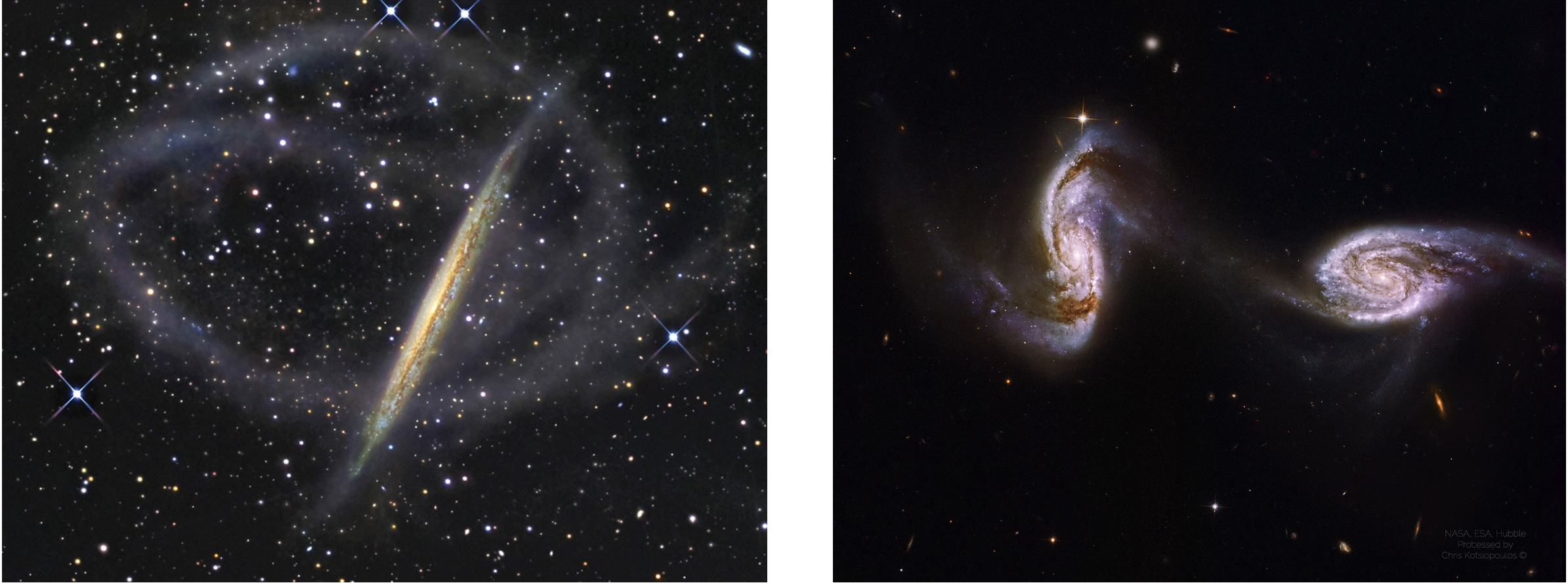
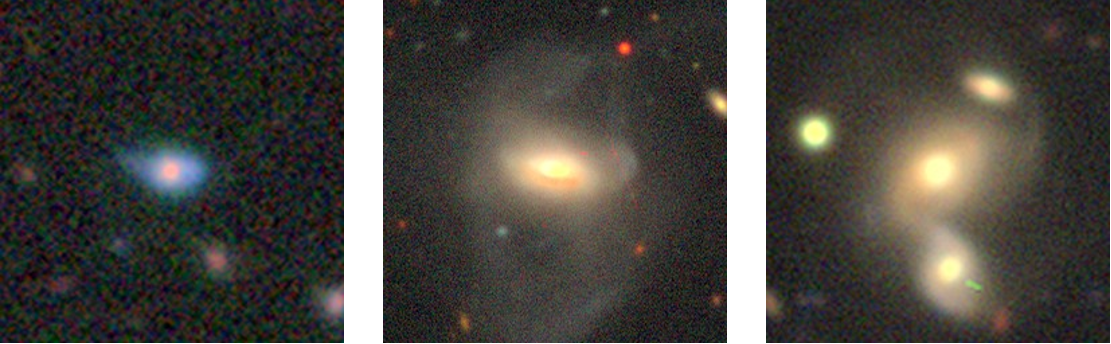
Understanding galaxy interaction is an incredibly challenging task. There are many different types of interaction (e.g. major interactions, wet interactions, coalescent mergers, etc.), which all affect galaxies differently. An example of a minor and
a major interaction (respectively) is shown below. Interaction occurs over such large timescales (usually a few hundred megayears to a gigayear) that we cannot simply sit back and watch one unfold. Instead, we must observe
many different interacting systems throughout the universe at different stages, and piece together the underlying processes at work from there. This investigation matters because our theories of
galaxy evolution (Λ Cold Dark Matter) hold that galaxies formed hierarchically — meaning a great deal of interaction and merging
of galaxies to form those we see today.
As we cannot watch these systems evolve naturally, we turn to simulations. There are three main types of simulation: magnetohydrodynamic, semi-analytic and numerical/N-body. Each has its own uses,
but my focus is on using numerical simulations to constrain interacting galaxies. We approximate the disk of each galaxy using a finite number of massless particles, and place them in the combined gravitational potential of the two
colliding galaxies. We then split the interaction into many discrete timesteps, calculating the forces on and velocities of each particle at each step to update its position. After running through all of the timesteps, the
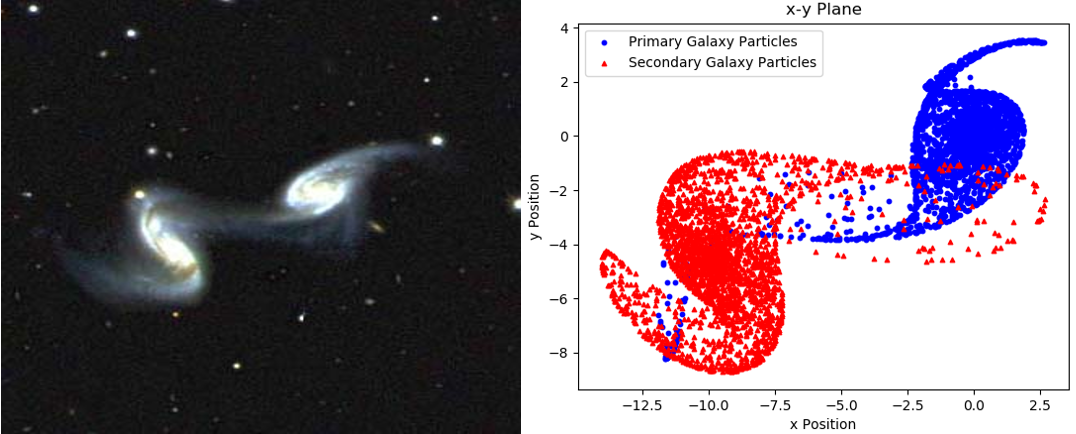
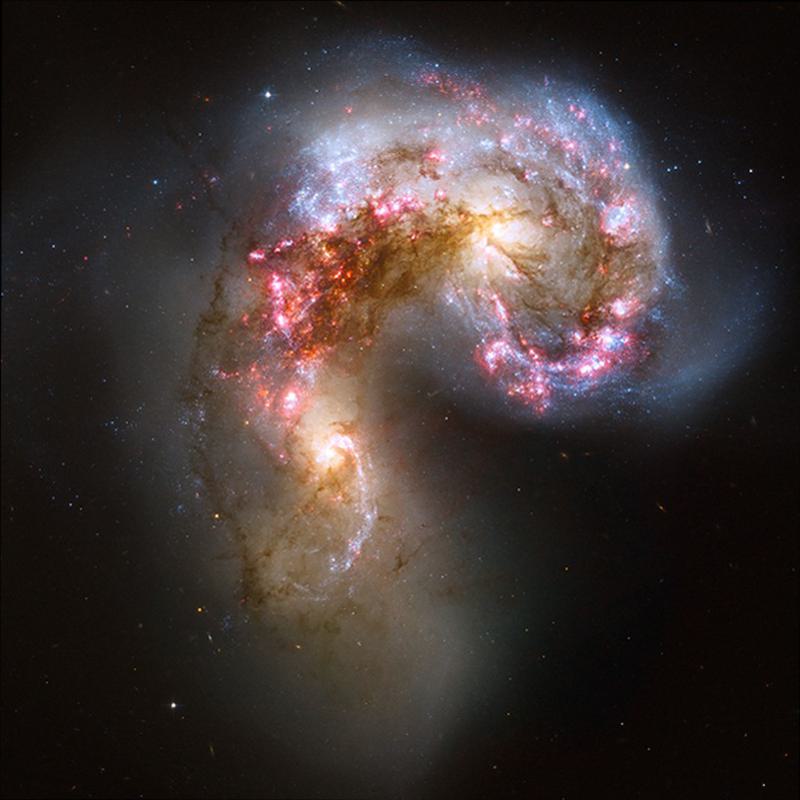
resulting particle distribution can resemble the actual distribution of our observed interacting galaxies. An example is shown below: our numerical simulation approximating the major interaction Arp 240, pictured above.
By imaging the position of each particle at every timestep, we can also create videos of the entire interaction.
The key takeaway from each of these simulations is that, to create them, we must estimate a host of underlying parameters for each galaxy. For example, to create the interaction above, we assumed that the primary and secondary galaxies had masses
of 2.23×10¹²M⊙ and 2.16×10¹²M⊙ respectively. We also had to assume the 3D position of the secondary, the size of each galaxy, how fast they were moving, and their relative orientation to one another. So, by building a simulation that approximates the mass distribution
of the interacting system, we can reasonably infer that the parameters used to create it are similar to the true underlying parameters of the real galaxies.
We take this a step further, however: we combine these numerical simulations of interacting galaxies, and their comparison to observations, with Bayesian statistics. Bayesian statistics lets us define a probability distribution for each parameter of the simulation — meaning we can not only find the best-fit parameters of an interacting system,
but also quantify how likely that fit is to be correct. This lets us investigate whether multiple parameter combinations can produce the same system — so-called degeneracies — and explore where these degeneracies arise and why. This will be an incredibly powerful approach, not just for interacting galaxies but for the formation mechanisms behind many
different kinds of astrophysical systems.
This project, then, focuses on building a pipeline that can find the most likely parameters of many different interacting systems using numerical simulations.
Once we can constrain these parameters across many systems with different characteristics, we will be able to explore the full impact of interaction on galaxy evolution
in a quantifiable way.
As described in my previous research project, constraining galaxy interaction is a notoriously challenging task. Even recognising interacting galaxies in observations comes with its own issues. If we want to find distinct types of
objects in astrophysical observations, we typically turn to two kinds of classifiers: machine learning (ML) or citizen scientists. We rely on these automated or delegated methods because of the sheer volume of
astrophysical objects being observed, with millions of sources potentially needing classification per night — far too many for a single researcher.
These automated and delegated methods work well for many different types of astrophysical object, except when it comes to interacting galaxies. The workhorse ML algorithm for classifying astrophysical sources is the
convolutional neural network, or CNN — essentially an image identification algorithm. We train the CNN to recognise certain features of interacting galaxies (i.e. two galaxies
close together, tidal debris, tidal bridges, etc.), and it classifies anything with these features as interacting. However, our observations of interacting galaxies are only a two-dimensional projection of the actual
three-dimensional system. So a CNN might confidently flag two objects close together in 2D as interacting, when in 3D they are actually kilo- or mega-parsecs apart. The only way to know for certain that two galaxies are close
together in physical space is by knowing their redshift. If they sit at similar redshifts and are close together in the plane of the sky, we know they are genuinely interacting gravitationally. An
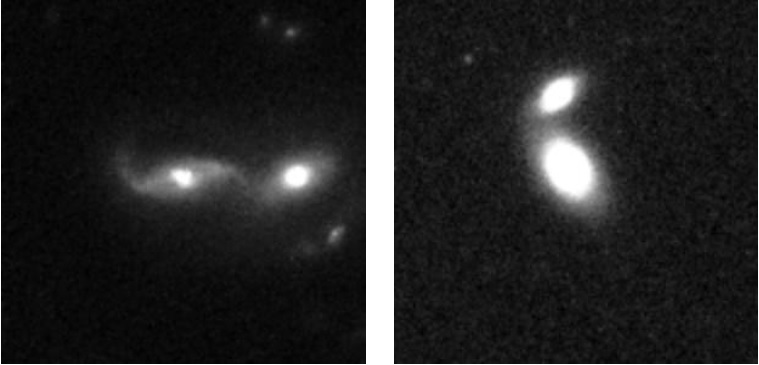
example of a genuinely interacting pair of galaxies, alongside two that are simply close by projection (i.e. a close pair), is shown below.
So why not just find the redshift of every galaxy we suspect might be interacting? Unfortunately, that's a non-trivial task — it requires extensive spectroscopic measurements, searching for
recognised elements in each galaxy. With tens of thousands of potentially interacting galaxies to confirm, this kind of observation and analysis quickly becomes unfeasible.
Other methods for inferring whether galaxies are interacting are currently under development. These often use the flux distribution of the galaxies, or naively estimate each galaxy's redshift by comparing it to simulated
disks. I'm working on using the shape of the systems alone to infer whether a galaxy is interacting. Using the Shapely Python package, it is possible to extract a polygon for each galaxy and then measure
how symmetric it is. Since interacting galaxies appear disturbed, and therefore asymmetric, we should be able to distinguish them from close pairs, which retain their symmetry.
The Galaxy Zoo collaboration has been running for nearly two decades. It is an online platform where volunteers classify images of galaxies by their morphology. These classifications range from
elliptical galaxies, to disk galaxies, to spiral galaxies, to disturbed galaxies, to even stars. Through this platform, millions of galaxies have been classified, giving astrophysicists
large, statistically robust samples of different galaxy types to explore and analyse.
The most recent data release of Galaxy Zoo is (or soon will be) Galaxy Zoo: Dark Energy Survey Instrument (DESI), containing nearly nine million deep images of galaxies at redshifts between 0 and 0.5. I, of course, am interested in the mergers and
disturbed systems in this latest release — in fact, it was the first classification tree to include a dedicated "Is the galaxy disturbed or merging?" question. This has let volunteers readily extract all of the
merging galaxies from the sample, split into "Not Disturbed", "Minor Disturbance", "Major Disturbance" and "Merger".
From my early analysis, there are at least 200k merging or interacting (minor- or majorly disturbed) galaxies in the sample, with another 100k requiring further inspection. With such a large, statistically robust sample, I will explore the relationship between the
CAS, GINI and M20 parameters of merging or interacting galaxies. For the development of these parameters, see Abrahams et al. (1994, 1996) and
Lotz et al. (2004). I will also use this sample to infer the merger rate across the observed redshift range, keeping in mind selection effects in Galaxy Zoo: DESI, and comment on new methods for identifying
interacting galaxies.
My final research project looks at star formation in interacting and merging galaxies. It is well known that interaction can, depending on the underlying parameters, lead a galaxy through a
starburst and eventual quenching. However, an open question remains as to where this intense star formation happens. Current theory holds that torques
exerted on the gas in the galaxy cause it to lose angular momentum, moving it towards the galaxy's centre. As the gas moves inward, its density increases to the point
where gravitational collapse of molecular clouds accelerates, and so does star formation. This inward movement of gas can also drive other effects on the galaxy, such as the ignition of nuclear activity.
However, this theoretical picture describes only one type of galaxy interaction: a major one. In such interactions, where the galaxies involved have close to equal mass, the torques are strong enough to drive the
processes described above. But if one galaxy is far less massive than the other (a minor interaction), or many orders of magnitude less massive (a micro interaction), the effects on the more massive galaxy (the primary) will barely be noticed. For the
less massive galaxy (the secondary), the results would be catastrophic — it would either be completely absorbed or destroyed by its more massive companion.
So where does star formation happen in these scenarios? Do we see an area of the primary galaxy where star formation is enhanced? Does the secondary's gas simply get split around the galaxy equally? Or do we see the same rush towards the
nuclear region as in the major-interaction case? All of this is without even considering the formation of tidal features, or the distortion and potential destruction of either galaxy's disk.
To answer this question, I aim to look for signs of star formation in interacting galaxies down to the sub-kpc scale. This should be achievable with the new William Herschel Telescope Enhanced Area Velocity Explorer
(WEAVE) multi-object survey spectrograph. This new, colossal spectrograph can take measurements of different regions within a galaxy. By looking for elevated intensities of either Hα (a sign of molecular gas over-density) or O[III] (a direct sign
of star formation) emission, we will be able to investigate where star formation is happening and whether it has been enhanced by the interaction or merger.
Internships
Throughout my undergraduate and, briefly, my postgraduate career, I have completed internships ranging from six-week summer placements to full three-month projects.
This page details each one, explaining its aims and results. For a quicker summary and list of my internships, see the relevant
section of my CV. While some of these projects relate to my PhD research, none of them have been the focus of my PhD. For my current
research projects, see my Research Interests page.
Click the drop-downs below if you would like to know more about each internship!
This internship focused on finding interacting galaxies throughout the entire Hubble Science Archives, using the new ESA Datalabs platform.
This platform lets a user "mount" the entire Hubble archive and access every observation as if it were a local file, removing the need to download source images before analysis. This matters because observation files
can take weeks to download when you need more than a few hundred of them — in this project, we needed 9,500.
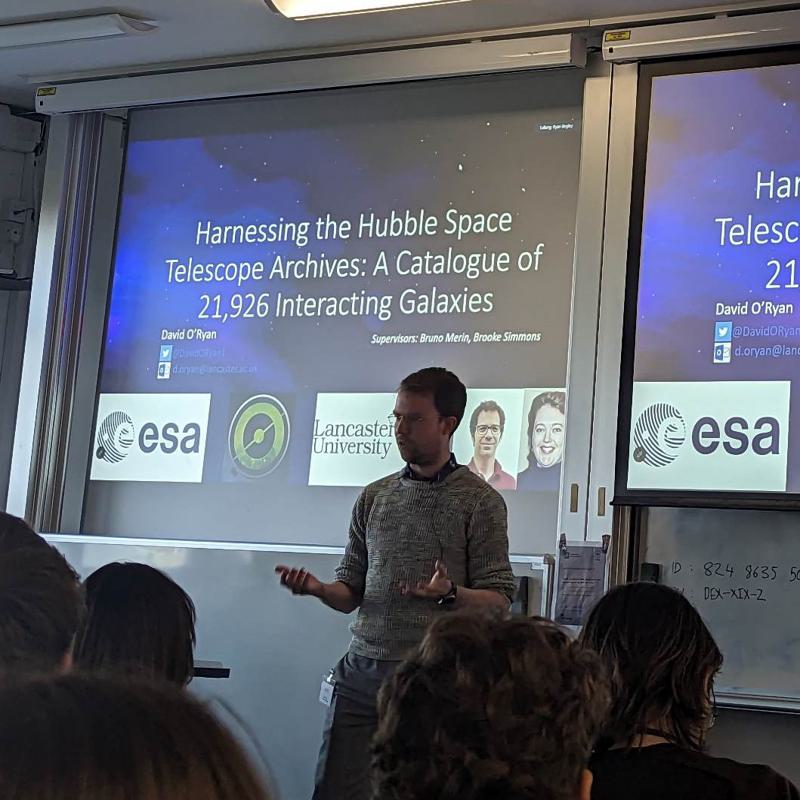
Using a newly developed machine learning algorithm called Zoobot, we classified over 126 million astrophysical sources into interacting and non-interacting galaxies.
After intensive contamination removal, we produced a pure catalogue of 21,926 interacting galaxies, released on Zenodo. In the process, we also
discovered many other astrophysical objects of interest buried in the archives, and released those catalogues at the same link.
For a full description of this work, see the pre-print on arXiv. This manuscript has been accepted by the Astrophysical Journal
and will be formally published soon.
Location: University of Glasgow, Glasgow, UK
Duration: 2.5 Months
Supervisor: Dr Pavan Chandra Konda
This internship was a step away from astronomy — my attempt to try something new. I went from studying galaxy evolution, and finishing my bachelor's thesis on mapping
molecular hydrogen in the Milky Way, to the Imaging Concepts Group at the University of Glasgow. This work focused on developing pill cameras
that use Single Photon Avalanche Diodes (SPADs) to image the gut.
Currently, imaging the gut or intestines requires a very invasive procedure: an endoscopy or colonoscopy. Here, a doctor inserts a camera attached to a cord
into the patient and navigates it to the area of the intestine or stomach to be imaged. As anyone who has been through this procedure will tell you, it is incredibly uncomfortable.
For a long time, an obvious alternative has been proposed: pill cameras. What if a patient could simply swallow a pill containing a small camera and a light, and have it image the
entire intestinal system over the course of a few hours?
This has been attempted with varying levels of success. The primary obstacle is the pill's battery requirement. The gut is a dark place and therefore requires illumination to
be detected by a CCD. With this extra requirement, the pill camera's battery often cannot last long enough, losing power before reaching the regions of interest.
This is where SPADs come in. These detectors are incredibly sensitive, able to detect single photons of emission, so with a SPAD as the camera we can use a low-power laser instead. This laser stimulates the gut's natural bio-luminescence,
which is then imaged by the SPAD.
There is a trade-off to this approach, however: what the SPAD gains in sensitivity, it loses in image resolution, often to the point of making the images unusable. So we employed super-resolution techniques to
reconstruct higher-resolution images from the SPAD, and investigated whether they could be used for medical purposes. This super-resolution would rely on the natural
movement of the pill camera through the gut via peristalsis, which would allow many images at slightly different positions to be taken and combined in post-processing. Unfortunately, we
discovered that (simulated) peristaltic motion would not be enough to reconstruct images of the required quality using super-resolution.
A common problem in our main cosmological model (ΛCDM) is the missing satellite problem: large cosmological simulations often produce fewer satellite galaxies than we observe in the real universe.
This is compounded by the seemingly rare nature of our own satellite galaxies orbiting the Milky Way and Andromeda.
The plane these satellites orbit in is very flat, almost matching the plane of the disk, and has a very distinct pole in momentum space, indicating that they are all
co-rotating with one another. The probability of this occurring by chance is exceptionally small, unless the Andromeda and Milky Way galaxies had a past encounter — but such an encounter would be incompatible with
ΛCDM cosmology.
However, an alternative theory of gravity predicts a close flyby between the Andromeda and Milky Way galaxies around 1 Gyr ago. That theory is Modified Newtonian Dynamics
(MOND). Using this theory of gravity, we ran numerous numerical simulations of the potential past encounter and studied the tidal debris and tidal satellites that would form. Not only did we find that we could recreate the strong
pole in angular momentum space, but we also naturally recreated the very flat orbital plane of the satellite galaxies. Other parameters were controlled for too, such as the resulting thin disk of the Milky Way and the expected number
of satellite galaxies actually escaping the Milky Way-Andromeda environment.
This work was published in MNRAS in 2018, and can be found here.
My first internship — and first experience of a research environment — was in studying galaxy evolution. In this project, I took the outputs of a Milky Way-analogous
galaxy in isolation, and studied the evolution of a galactic bar at its centre. The aim was to eventually use the simulation
results to investigate the likelihood of a bar at the centre of the Milky Way.
To this end, we found that a strong bar formed at the centre of our simulation and grew substantially over time. However, we did not reach the goal of comparing these results to observations
from within the Galaxy. It was still an excellent experience, and prepared me well for future internships and for my PhD. It also sparked
my love for studying galaxies and galaxy evolution — a subject I had not yet encountered as an undergraduate at Glasgow.
Academic & Public Outreach
In this section, I detail the talks and seminars I have given and, where possible, link to recordings for anyone who's interested. I've also listed the
outreach work I conducted while at Lancaster.
Talks and Seminars
Seminars
Creating a Large Interacting Galaxy Dataset with the ESA Hubble Archive, Galaxy Zoo Labels and Deep Learning (Location: University of Lancaster, UK)
Creating a Large Interacting Galaxy Dataset with the ESA Hubble Archive, Galaxy Zoo Labels and Deep Learning (Location: European Space Astronomy Centre, ESA)
Contributed Talks
Creating a Large Interacting Galaxy Dataset with the ESA Hubble Archive, Galaxy Zoo Labels and Deep Learning (Location: University of Edinburgh, UK)
Throughout my postgraduate degree at Lancaster, I was a teaching assistant on several courses. While I don't have any lecturing experience yet, I do have experience helping to teach and mark the courses below. Click the drop-downs
for details on each!
This course taught students the mathematical descriptions of waves and harmonic oscillators. It was a challenging one for its students, requiring strong skills in algebra and the visualisation of systems.
The material progressed from the basics of harmonic oscillators, through mechanical and standing waves, to calculating transmission and reflection coefficients.
The second-year AstroLab course at Lancaster was essentially a set of laboratory experiments, using mock or real data, that students conducted over a two-week period. Across four five-hour sessions, they would run an experiment, write up a
full report and have it returned fully marked. I ran one experiment each semester: mapping Hertzsprung-Russell diagrams of a stellar population, and calculating its age and characteristics.
These two courses taught basic and advanced quantum mechanics to students at Lancaster. It was mathematically intensive, starting from the stationary Schrödinger
equation and ramping up to quantum descriptions of different molecules. I had also found this course incredibly difficult as an undergraduate, but teaching it gave me
a new understanding and appreciation for the material.
This was an interesting course to teach, as it essentially taught students code craftsmanship and critical thinking. Each student chose a programming project (often some kind of simulator) and built
it from scratch. I found this was the best way to teach programming, with students' skills improving massively over the six-week course. My job was mainly to check in on students as they worked, and help with any bugs or technical issues
they ran into.
David O'Ryan
Hi there! I am an ESA Research Fellow at the
European Space Astronomy Centre, Madrid, Spain. My research
focuses on understanding the relationship between galaxy morphology, galaxy
environments, and galaxy evolution.
This website summarises my work, what I'm up to, and a bit more about me. If you have any questions, don't
hesitate to get in touch!